The Elite Code for Teams
Why some teams win, and others don't…
A keynote, workshop and leadership programme that turns forty years inside the world's greatest sporting teams into the specific, learnable architecture that makes ordinary groups perform like extraordinary ones, and keeps them performing through change, pressure and disruption.
Built for leadership teams, boards, departments and organisations going through change.
If any of this sounds familiar, you are in the right place.
Your team is full of capable people, but it does not perform like the sum of its parts. Bringing in a brilliant new hire seems to lower the temperature of the room rather than raise it. Your best players win individually but struggle to win together. Standards drift the moment you stop watching them. When pressure rises, the team fragments rather than tightens. Reorganisations and changes of leadership leave a long shadow that the team never quite shakes off. Performance feels permanently below potential, and you cannot quite work out why. None of this is a failure of the people in the team. It is the absence of a deliberate, learnable architecture that the greatest sporting teams in history have spent decades perfecting. The Elite Code for Teams is what they learned, brought directly into your organisation.
Let’s Talk!
Contact Alison: ak@alisonkervin.co.uk
The difference is not just who is in the team. It is what connects them.
Jim Collins was right. The first job of any leader is to get the right people on the bus. Without the right people, no amount of strategy, culture or coaching will save you. But here is the part most organisations underestimate. Once you have the right people, what determines whether they win consistently is not their individual quality. It is the architecture between them. The cohesion. The shared standards. The distributed leadership. The culture that protects the team's performance even when the named leader is not in the room. In forty years covering elite sport, I watched teams of extraordinary individuals collapse on the biggest stages, and teams of ordinary individuals win World Cups. The difference, every single time, was the invisible architecture connecting them. The Elite Code for Teams is what that architecture looks like, and how to build it inside your organisation.
What changes for your team?
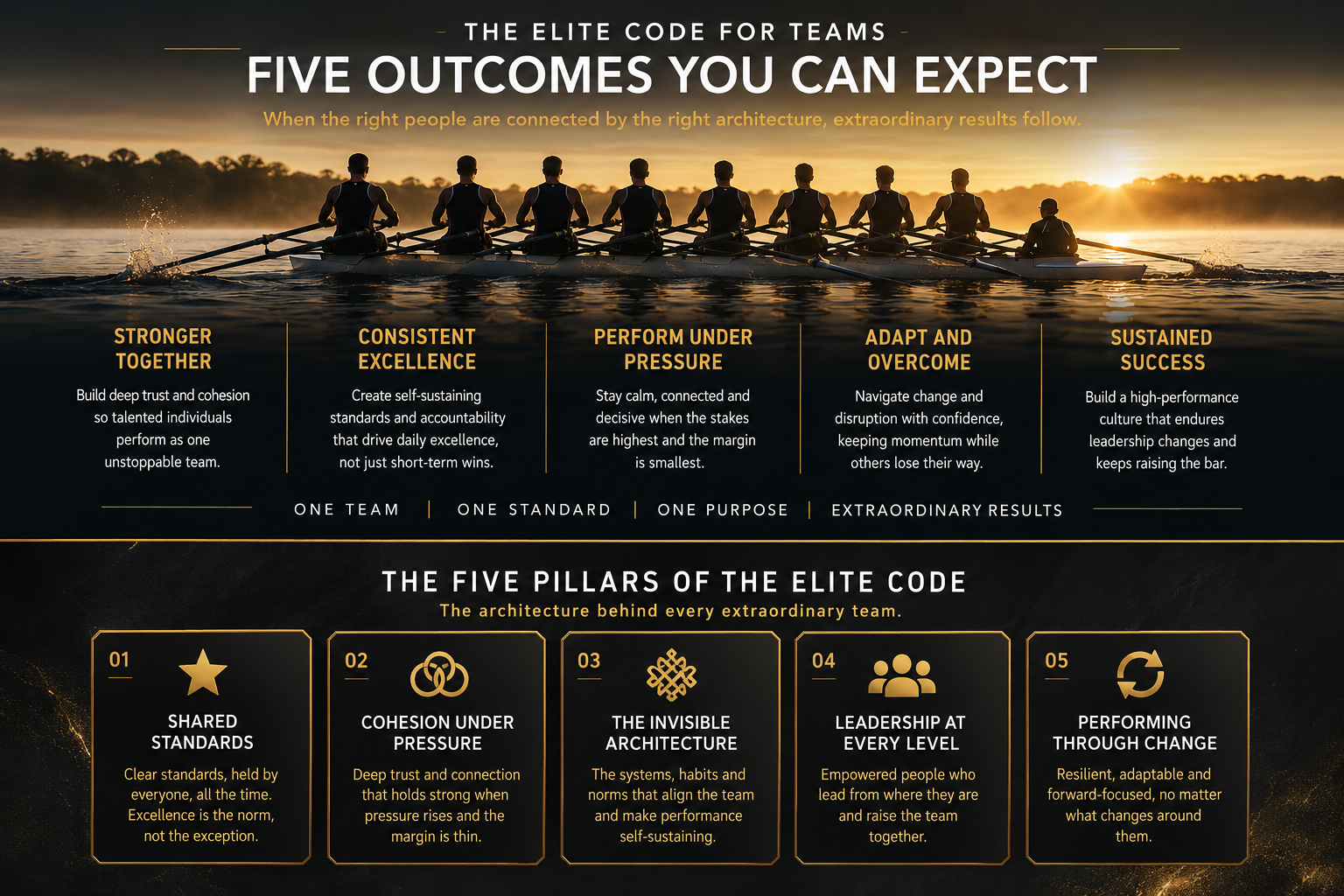
By the time your team has absorbed the Elite Code for Teams, the difference will not be in what they know. It will be in how they behave when it matters. They will understand precisely why the team is performing below its potential, because they will finally have a language and a framework for diagnosing it. They will build the cohesion that makes talented individuals perform as a genuine unit, not a collection of strong solos. They will create a culture in which high standards become self-sustaining, holding each other to account without triggering hierarchy or conflict. They will lead more effectively through periods of disruption and change, because their foundations will be deeper than any restructure can shake. And they will perform consistently when the pressure is highest, and the margin is thinnest, because they will have rehearsed exactly that, the way the greatest teams in sport always do.
The Five Pillars of the Elite Code for Teams.
Forty years of interviews with the architects of the greatest team performances in sporting history, and one consistent pattern. The same five pillars kept appearing across every sport, every era and every culture. Each one breaks down into five specific behaviours, giving twenty-five learnable habits in total. Here is how each pillar works, and some of the teams who taught me about it.
01 Shared Standards
The greatest teams build internal standards that every member holds themselves and each other to, without being told. The All Blacks, the most successful team in the history of professional sport, live by a famous internal rule. No matter how talented you are, you cannot be bigger than the team. They call it the no dickheads rule, and it is enforced not by the coach but by the players themselves. New caps clean the changing rooms. Senior players challenge anyone who drops standards, immediately and without hesitation. Coaches protect the culture as fiercely as they protect tactics. The result is a team that has dominated rugby for over a century, through generations of players, coaches and rule changes. Standards in environments like that are not enforced from the top. They are held by everyone, all the time, including when nobody important is watching. Your team will leave knowing how to build that self-sustaining culture of accountability, the kind that makes excellence the daily norm rather than a quarterly initiative.
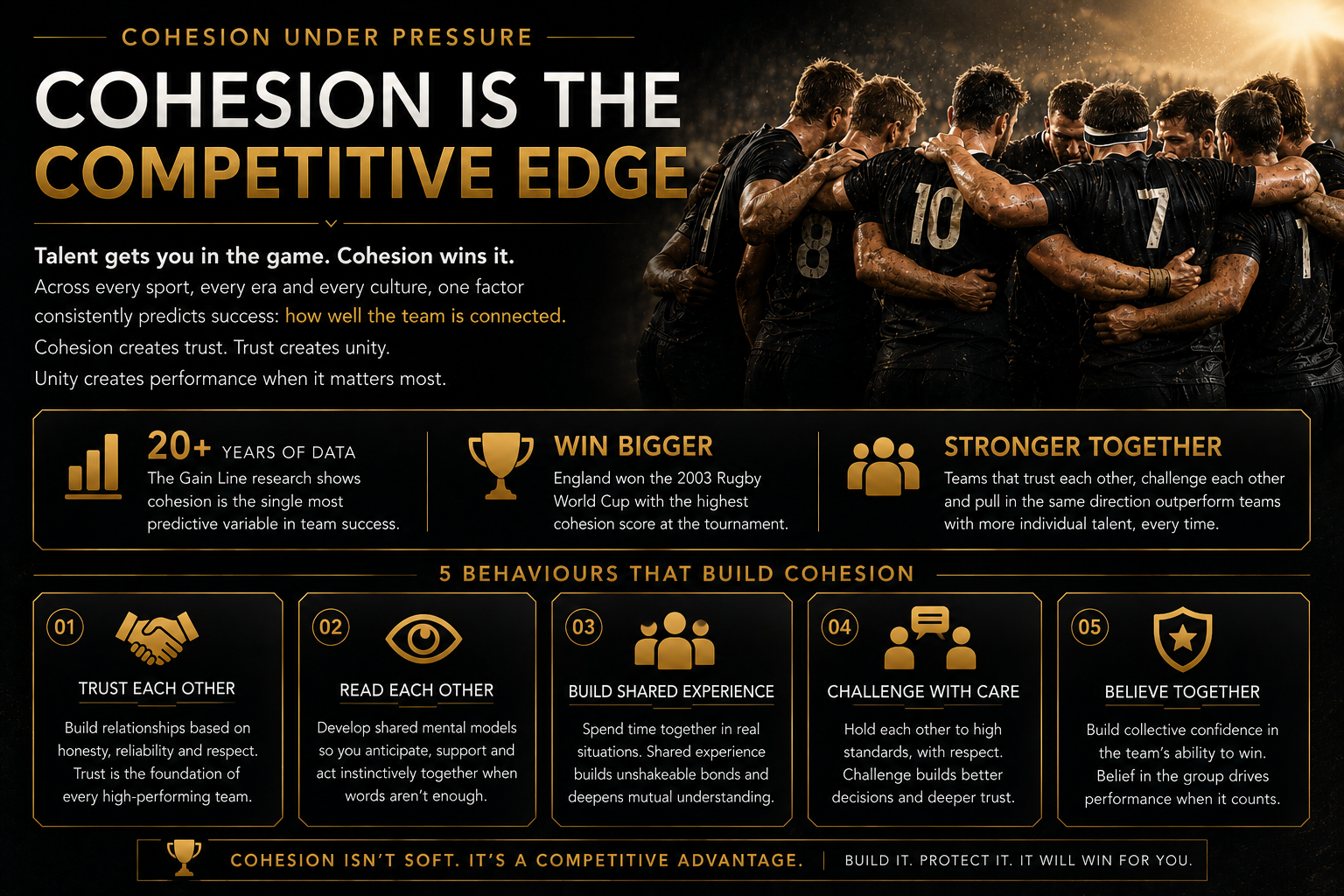
02 Cohesion Under Pressure
England won the 2003 Rugby World Cup not because they had the best individual players, although several were world class. They won because they had the highest cohesion score of any side at the tournament. Cohesion, as the analysts at Gain Line have shown over twenty years of data, is the single most predictive variable in international team success. It is why Germany consistently outperform England at football World Cups, despite England's deeper talent pool. The core of the German national side plays together at club level every week, building bonds without the coaches having to do anything at all. England's players, by contrast, are scattered across twenty Premier League sides who barely speak to each other. The Manchester United class of 1992 were not, individually, outstanding players. As a team, they shone for years because they were kept together long enough to develop the deep mutual trust that genuine cohesion demands. Shared experience beats individual brilliance every single time. Your team will leave knowing how to build that trust, how to protect it, and how to recover it when restructures threaten it.
03 The Invisible Architecture
Culture is not a values statement on a wall. It is the sum of what people do when nobody important is watching. A Marks & Spencer employee, at the company's peak, once refunded a customer for a suit the company had never sold. The suit was unmistakably M&S in style, but no record of the sale existed. They refunded it anyway. Not because the rulebook said so, but because in that culture, doing the right thing was simply what you did. Sir Dave Brailsford built the same kind of architecture inside British Cycling, the philosophy he called marginal gains. Every variable that touched performance, however small, was examined and improved. The pillows the riders slept on. The way they washed their hands to avoid winter colds. The wash bags they carried. None of those changes won races on their own. Together, layered into a system, they made British Cycling the most dominant team in the sport's history. Genuine team architecture is not built by grand gestures. It is built by hundreds of small, deliberate decisions about what excellence looks like in this team, on this day, with these people. Your team will leave knowing how to build the habits and environments that make excellence the daily norm.
04 Leadership at Every Level
The greatest teams I observed did not depend on a single charismatic leader. The England women's hockey team that won Olympic gold in Rio was a remarkable example. They beat the technically stronger Netherlands not because they had a captain who delivered an extraordinary speech, but because every player in that squad had been trained to lead in the moment that required them. The defenders led the back line. The strikers led the press. The goalkeeper, Maddie Hinch, owned the penalty shootout because she had personally studied every Dutch penalty taker in obsessive detail. Leadership in that team was not a hierarchy, it was a habit, distributed through the squad in such a way that the team kept performing whether or not the named leader was on the pitch. Compare that to the teams that fall apart the moment their captain is injured, or the leaders who hoard authority until nobody else can act without permission. Your team will leave knowing how to build leadership as a habit rather than a hierarchy, the kind of distributed strength that performs whether or not the named leader is in the room.
05 Performing Through Change
The teams that sustain performance through disruption are not the ones with the most talent. They are the ones with the deepest foundations. When Manchester United moved on from Sir Alex Ferguson, they had the talent on paper to keep winning. What they lacked was the foundation underneath. Every change of coach, every transfer window, every restructure further diluted the cohesion that had made the team great in the first place. New players arrived faster than old players could integrate them. Standards drifted because the people who had embodied them were no longer in the changing room. Compare that to the All Blacks, who have lost senior players, head coaches and entire generations of stars over the decades, yet have remained the most successful sporting team in history. Their secret is not talent renewal. It is the architecture underneath, deep enough to absorb change rather than be broken by it. Or compare it to Red Bull Racing, who have built a system in Formula One in which the strength comes not from any single driver but from engineers, strategists, mechanics and analysts working together at extraordinary speed. Lose a driver and the system holds. Your team will leave knowing how to build that depth, the kind that performs not despite change but through it, no matter who comes and goes.
This is not a team-building day.
The Elite Code for Teams is not trust falls, away-day exercises or motivational posters. It is a serious, evidence-based exploration of what actually makes the difference between teams that win consistently and teams that underperform despite having the talent to do better. Every insight comes from inside the world's greatest sporting teams, told by the people who built them. It is honest, practical, occasionally funny, and rooted entirely in real stories of real teams who got to the very top of their fields and stayed there. It works powerfully for leadership teams, boards, departments, organisations going through change, and any group of capable people who know they should be performing at a higher level than they currently are.
The questions this session answers.
Why do some teams outperform the sum of their individual parts?
Why can bringing in a brilliant individual damage an otherwise strong team?
What do the All Blacks, the England women's hockey team and the Manchester United class of '92 share?
Why do some great players perform badly after moving to a new team?
How do you build a culture where high standards sustain themselves?
What is the real impact of leadership on team performance, and how do you measure it?
How do the best teams maintain performance through disruption and change?
What separates a team that wins once from one that wins consistently over time?
Available as
Keynote, 60 to 90 minutes. Ideal for conferences and leadership events.
Half-day workshop. Practical and interactive, designed for senior teams.
Leadership away-day. The full team programme, with real behavioural change as the goal.
Executive advisory. Ongoing engagement for organisations going through change.
Every session is delivered personally by Alison Kervin OBE.
What people say.
"Truly groundbreaking. She became a role model for women working in a historically male-dominated environment."
Sir Clive Woodward, World Cup-winning coach
"Her work has helped break the gender barrier for women on the field of play and in administration."
Lord Sebastian Coe, President of World Athletics
"Exceptional at connecting valuable life lessons with hugely entertaining anecdotes. She delivers passion, shock and laughter in equal measure."
Victoria Sugg, CEO, Emperor
"What stood out in a very tangible way was her message of perseverance. Against odds that were often not in her favour, she did it anyway, and in such style. I went home and recounted many of her tales to my team. Outstanding, and we all benefited immensely."
Kate Rainford-Foakes, SmallBiz100 Entrepreneur and IAlso100 Founder
The greatest teams are built, not assembled.
Bring the Elite Code for Teams to your organisation.
If you are planning a leadership conference, a team away-day, an executive offsite or a longer programme of cultural change, I would love to talk to you about it. Every session is built around your team, your industry and the specific outcomes you want them to leave with. The first conversation is always free, and there is no obligation.
Email Alison directly: ak@alisonkervin.co.uk
Telephone: 07880 505607